Article Directory
In the high-volume B2B market for concentrated beverages, such as syrups, liquid tea, and coffee concentrates, the final liquid residue remaining in the packaging is a direct and quantifiable loss. For Tea & Coffee Liquid Bag-In-Box (BIB) Packaging, the Evacuation Rate (ER) is a critical performance metric; a difference of just 1-2% residue can equate to thousands of liters of lost product yield across a large-scale contract. Therefore, engineering the inner bag to achieve the highest possible evacuation rate (often > 99%) through precise design is essential for economic viability.
Suzhou Jingle Packaging Technology Co., Ltd., located in the WuJiang Economic Development Zone, excels in developing liquid flexible packaging solutions. Our team, with over 15 years of industry experience and strong technical knowledge, utilizes advanced bag-in-the-box production lines to actively explore and deliver solutions that minimize residue and maximize yield, a key focus of our Bag-in-box residue reduction engineering.
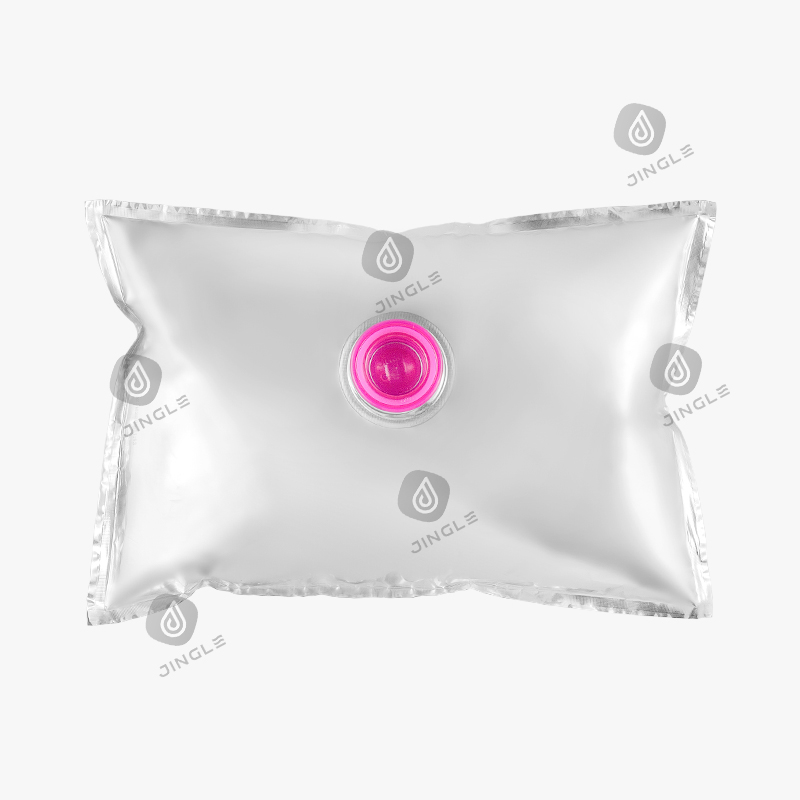
The physical shape of the inner bag dictates how uniformly it collapses, which directly impacts the adherence of liquid to the inner film surfaces.
The two prevalent bag styles are the simple pillow bag (formed by two flat sheets sealed at the perimeter) and the gusseted bag (featuring inward folds at the sides). The gusseted design is generally superior for high-viscosity concentrates, a key finding in the Gusseted vs pillow bag design for liquid dispensing analysis. The structured folds of the gusseted bag allow for a more controlled, uniform collapse toward the spout, minimizing pockets where liquid can be trapped. In contrast, the simpler pillow bag can sometimes crumple unevenly, trapping liquid in its folds.
| Bag Geometry | Collapse Mechanism | Typical Residual Liquid Rate (Concerns) |
|---|---|---|
| Pillow Bag | Uncontrolled/Random Crumpling | Higher residual liquid (> 1.5%); uneven collapse pockets |
| Gusseted Bag | Structured/Controlled collapse towards spout | Lower residual liquid (< 1.0%); superior for achieving High evacuation rate BIB bag design |
Achieving optimal Liquid flexible packaging collapse performance requires more than just shape; it requires the correct film material. The inner contact layer of the film must possess a low coefficient of friction (COF) and a low modulus of elasticity (high flexibility). Low COF prevents the film layers from sticking together prematurely during dispensing, ensuring a complete, smooth collapse, while high flexibility minimizes the film's tendency to spring back and create internal vacuum pockets that trap product.
The final liquid residue is most influenced by the location and design of the dispensing fitment.
The most crucial engineering element is Spout placement optimization for liquid residue minimization. For maximum evacuation, the spout must be positioned at the gravitational lowest point of the bag when the BIB is positioned for dispensing. For standard cubical boxes, this typically means the spout should be located either in the absolute center of the bottom edge or integrated into one of the lower corners of the bag's perimeter seal. Placing the spout too far from the corner or too high relative to the box base will always create a 'sump' of unrecoverable product.
The design of the fitment itself is an integral part of Bag-in-box residue reduction engineering. The internal geometry of the spout flange must minimize any dead space, internal reservoirs, or large cavities where viscous liquid can pool and adhere. For a High evacuation rate BIB bag design, the seal area surrounding the spout is often reinforced to ensure that the surrounding film can be pulled taut into the fitment area without rupturing, ensuring the final milliliters of product are drawn out.
The theoretical performance of the design must be rigorously validated and consistently executed in manufacturing.
Achieving high evacuation rates depends on the manufacturing line's ability to maintain high precision. Our advanced bag-in-the-box production line ensures the accurate placement and secure welding of the spout, minimizing tolerance errors that could accidentally raise the lowest dispensing point, thereby compromising the Spout placement optimization for liquid residue minimization achieved in the design phase.
For B2B quality control, the final evacuation rate must be quantitatively verified. This involves gravimetric testing: the bag is weighed full, dispensed according to the intended method (e.g., pumped until draw-down), and then weighed empty. This testing verifies the High evacuation rate BIB bag design and provides concrete data to the customer on expected product yield.
In the highly competitive market for liquid concentrates, superior Tea & Coffee Liquid Bag-In-Box (BIB) Packaging is defined by its efficiency. Technical mastery of bag geometry, particularly the choice between the Gusseted vs pillow bag design for liquid dispensing, combined with engineering precision in Spout placement optimization for liquid residue minimization, are the critical factors that drive the final Evacuation Rate. Suzhou Jingle Packaging Technology Co., Ltd. applies this deep technical knowledge to deliver products that ensure customers achieve maximum yield and minimum waste through effective Bag-in-box residue reduction engineering.
Address
No. 758 Longqiao Road, Wujiang Economic Development Zone, Suzhou, Jiangsu, China, 215200
cs3@suzhoujingle.com ( Ellie Li )
sales-sea@suzhoujingle.com ( Alex Too )
billhe@suzhoujingle.com ( Bill He )
kennyyan@suzhoujingle.com ( Kenny Yan )
Phone
+86-51263068181
Fax
+86-51263068282

Suzhou Jingle Packaging Technology Co., Ltd. mainly develops and produces Aseptic BIB Packaging/Bag Products for food, beverage, and non-food fields, supporting the filling equipment, selling self-produced packaging products, and providing corresponding after-sales services.
Keep in touch

 English
 中文简体
中文简体
 русский
 Español