Article Directory
The Tea & Coffee Liquid Bag-In-Box (BIB) Packaging format is widely adopted for its efficiency and extended shelf life, particularly when used for concentrate or ready-to-drink products. To ensure microbiological safety and stability, these liquids often undergo high-temperature processing, either through hot filling (typically 85°C to 95°C) or steam sterilization/retort (up to 121°C or higher) for aseptic applications. This thermal exposure places extreme stress on the packaging material. The film laminate must be meticulously engineered to maintain its critical barrier, flexibility, and—most importantly—its seal strength under these conditions.
Suzhou Jingle Packaging Technology Co., Ltd., located in the Wujiang Economic Development Zone near Shanghai, specializes in developing and producing liquid flexible packaging products for the food, beverage, and non-food sectors. Our team's over 15 years of industry experience and strong technical knowledge enable us to provide precise, complete solutions that address the stringent material science requirements of high-heat processing for B2B customers globally.
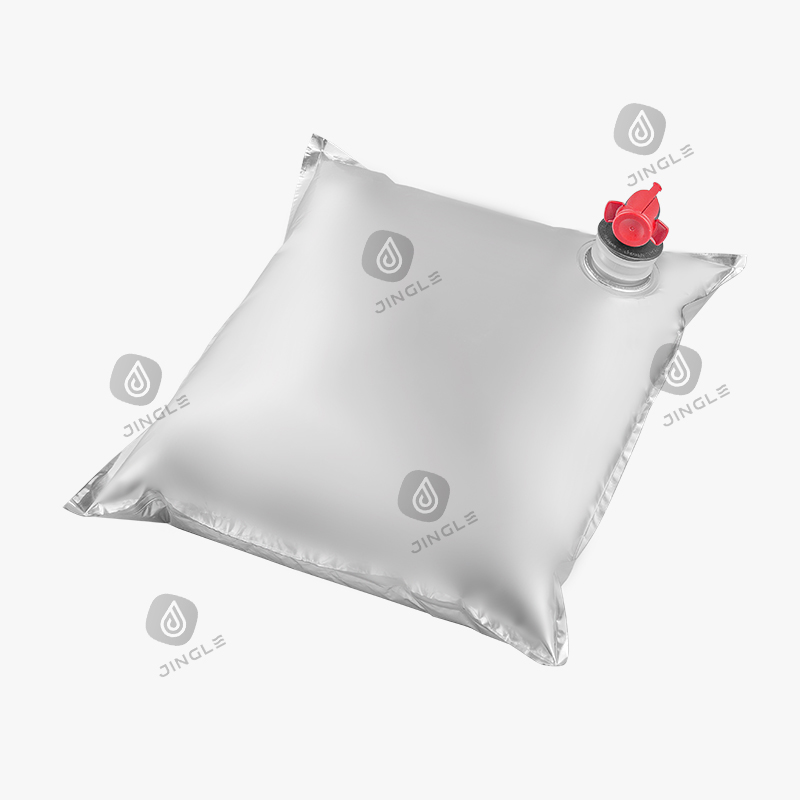
The film used in an aseptic BIB must be a multi-layer composite, where each layer contributes specific functionality to handle thermal stress.
The complexity of a High-temperature resistance BIB film structure lies in selecting materials that will not soften, delaminate, or lose structural integrity below the maximum processing temperature. The critical outer layer and the heat sealant layer must have high melting points and excellent thermal stability. For the heat sealant layer, specialized Polyethylene (PE) resins, particularly those with a narrow molecular weight distribution (e.g., high-Melt Flow Index LLDPE or metallocene PE), are chosen over standard LDPE because they offer a higher softening point and superior creep resistance under heat. This is crucial as it dictates the maximum safe processing temperature.
| Sealant Polymer Type | Typical Max Processing Temp (Hot Fill) | Seal Strength Consistency |
|---|---|---|
| Standard LDPE | ~ 85°C | Moderate; prone to creep at high heat |
| Specialized LLDPE/mPE | ~ 95°C to 121°C+ (Meets High-temperature resistance BIB film structure requirements) | Excellent; high resistance to thermal deformation |
Oxygen barrier materials, such as metallized PET or EVOH, are vital for preserving the flavor and aroma of tea and coffee concentrates. These are typically the most heat-sensitive layers. When formulating Polymer layers for hot fill liquid packaging, engineers must ensure that the thermal shock from hot filling does not induce thermal expansion differences between adjacent layers that could create microscopic fissures in the barrier layer, leading to oxygen ingress and product spoilage.
The seal area is the most vulnerable point during and after high-heat processing. Preventing its failure is paramount to safety and product life.
High-speed hot filling requires the sealant layer to bond instantly and maintain strength despite the immediate temperature exposure. Loss of Laminated film seal strength post hot filling can occur if the residual heat from the product causes the seal layer to weaken before it fully crystallizes and sets. Therefore, manufacturers must use precise heat sealing equipment with monitored temperature control and rapid cooling capabilities. Quantitative quality control demands measuring the peel strength after thermal shock; acceptance criteria typically require maintaining greater than 90% of the initial seal strength to ensure reliability.
For true aseptic applications involving steam sterilization (retort), the Tea & Coffee BIB packaging heat seal integrity must withstand significant pressure differences. Aseptic bag-in-box steam sterilization requirements dictate that the film must be resilient against steam penetration and the pressure differential between the retort chamber and the inside of the bag. The structural layer (often a co-extruded Nylon/PE or thicker linear PE) ensures the mechanical robustness necessary to prevent the formation of pinholes or stress-induced cracking, especially near the spout area where heat and mechanical stress converge.
Consistent high performance in thermal packaging is achieved through advanced manufacturing and rigorous technical oversight.
Suzhou Jingle is equipped with an advanced production line capable of producing the complex, multi-layer, high-barrier bags necessary for aseptic processing. This advanced capability ensures uniform layer thickness and homogeneous bonding, which are non-negotiable for achieving reliable High-temperature resistance BIB film structure that our customers rely on.
Our team members, with over 15 years of experience, possess the technical depth to understand specific customer requirements—such as the exact retort temperature needed for a particular coffee concentrate—and translate that into the ideal Polymer layers for hot fill liquid packaging and sealing parameters.
The success of Tea & Coffee Liquid Bag-In-Box (BIB) Packaging in the high-heat sector hinges entirely on precision material engineering. Achieving a reliable and durable solution requires mastering the science behind High-temperature resistance BIB film structure and guaranteeing Laminated film seal strength post hot filling. Suzhou Jingle Packaging Technology Co., Ltd. provides the advanced production and technical expertise to deliver packaging that maintains its integrity under the most demanding thermal conditions, ensuring product safety and longevity.
A: Hot filling typically involves filling the product at 85°C to 95°C and relying on the heat to sterilize the container. Aseptic bag-in-box steam sterilization requirements involve a full retort process, often reaching 121°C or higher, requiring the packaging film to withstand direct steam and pressure for a defined period, making the High-temperature resistance BIB film structure much more critical.
A: This is prevented by selecting sealants with high softening points (like specialized mPE) and ensuring the sealing equipment applies precise temperature and pressure followed by rapid, localized cooling. Rapid cooling accelerates the sealant's crystallization, minimizing the time it spends in a softened state due to residual product heat.
A: The most heat-sensitive component is typically the oxygen barrier layer (e.g., EVOH or metallization). High heat can compromise the integrity of this layer through differential thermal expansion or chemical degradation, leading to premature loss of product freshness.
A: Flexibility is crucial because the bag must collapse efficiently as the product is dispensed to prevent air ingress and oxidation (known as 'pump-out' performance). If the film stiffens or becomes brittle after heat treatment, its functionality and product shelf life are severely compromised.
A: While peel strength verifies the seal, barrier integrity is verified using tests like Oxygen Transmission Rate (OTR) testing on samples that have undergone simulated thermal processing. This ensures that the barrier's performance (often critical for Tea & Coffee Liquid Bag-In-Box (BIB) Packaging) has not been damaged by the heat shock.
Address
No. 758 Longqiao Road, Wujiang Economic Development Zone, Suzhou, Jiangsu, China, 215200
cs3@suzhoujingle.com ( Ellie Li )
sales-sea@suzhoujingle.com ( Alex Too )
billhe@suzhoujingle.com ( Bill He )
kennyyan@suzhoujingle.com ( Kenny Yan )
Phone
+86-51263068181
Fax
+86-51263068282

Suzhou Jingle Packaging Technology Co., Ltd. mainly develops and produces Aseptic BIB Packaging/Bag Products for food, beverage, and non-food fields, supporting the filling equipment, selling self-produced packaging products, and providing corresponding after-sales services.
Keep in touch

 English
 中文简体
中文简体
 русский
 Español